Tuesday, June 26, 2007

The Responsorial Psalm reexamined

At the June 2007 Sacred Music colloquium, CMAA President Prof. William Mahrt gave a talk Friday night about the Responsorial Psalm, which is commonly used after Vatican II instead of the Gradual. Some believe that the Gradual was superseded by the Responsorial Psalm after Vatican II. Actually, guidelines currently in effect say that either is permissible.

The Gradual needs to be sung or at least led by a choir. It is proper to the occasion, which means a new one needs to be prepared for almost every Mass. Its form is in keeping with its liturgical function. Coming directly after the Lesson, it seems to be designed to complement it. In the Gradual, a small amount of text is sung to "the greatest number of notes," in tune with its purpose of aiding reflection while the congregation is absorbing the lesson. Prof. Mahrt said that in his experience, white noise stops dramatically after the Gradual is sung, because after the music has done its job, the congregation has effectively become recollected.

For an example of the beauty of the Gradual, Prof. Mahrt had those of us in the women's schola sing the Gradual for the Feast of the Nativity of St. John the Baptist, which we had been practicing for the upcoming feast day. He contrasted the ornate richness of the Gradual with the relative insipidity of the feast's prescribed responsorial Psalm, for which the congregation sings the Antiphon: I praise you, for I am wonderfully made to an awkward melody.

The antiphonal singing of the Responsorial Psalm engages the congregation in an activity. Its melodies are not interesting or effective. Even though the documents say that its purpose is meditation, Mahrt wonders, since it does not further recollection, what purpose does it have, then? Some liturgists say that it is designed to give the congregation something to do.

In his writings and in his lectures, Mahrt often explains that the post-Vatican II guiding phrase "active participation," which is quoted often to justify keeping the congregation busy by singing in parts of the Mass where the choir used to sing, does not actually mean the congregation must be singing. Active participation can and should be attentiveness and contemplation during the times when it is most appropriate, such as during the opening procession, or when the lessons should be absorbed and pondered, or when the congregation is approaching the altar for Communion.

Prof. Mahrt then gave some well-developed suggestions for gradual (no pun intended) musical compromises that a choir director might introduce in stages that could lead to the full use of the Gradual in a Church's Masses.

Related to this topic, here is a little adventure of mine that reinforced what I'd learned from the lecture. On the last day of the colloquium, I wandered into the upper Shrine of the Immaculate Conception while in last minute search of subjects to photograph. I chanced into the middle of a Mass with multiple concelebrants at the moment when the cantor was leading the people in the day’s simple little antiphon for the responsorial psalm: I will praise you for you are wonderfully made.

And I was struck by the contrast between the loftiness of the Church and the impressive appearance of the multiple vested concelebrants on the one hand and the flatness of the text and the triviality of the melody. Any of the treatments Prof. Mahrt provided in his talk on the Gradual would have been much more in keeping with the solemnity of the moment and the surroundings.

Here is the Gradual sung by the women's schola in Mahrt's Gradual class and at two Masses we sang for the Feast of the Nativity of St. John the Baptist.

P.S.
Since I first wrote this, I found a good discussion on how to include the Gradual by Jeffrey Tucker and a lot of educated comments at the New Liturgical Movement blog.

Tuesday, June 12, 2007

Hint: Winter, Spring, Summer, and Fall. Question: What's an Ember Day?

Reading Apel's Gregorian Chant Chapter Two about the liturgy, I came across the term Ember days. I remember hearing the term when I was a kid, but I never understood them or remember seeing them observed.

What I do know at this point is that Ember days used to be observed during one week at the start of each of the four seasons of the year. During those weeks, Wednesday, Thursday and Saturday were set aside for fasting and prayer.

Ordinations to the diaconate and the priesthood occurred on Ember Saturdays. I recently attended the ordination of my brother in Carmel, Lawrence Poncini OCD, on the Saturday after Pentecost, which is an Ember Week. So, it seems that even though the United States Conference of Catholic Bishops has downplayed Ember days, and even though their observance has just about disappeared, ordinations are still performed according to the old observance.

The Latin name for those four times was Quatuor Temporum -- which means Four Times. They occurred in Winter during Advent (after St. Lucy's feast on Dec. 13), Spring (after Ash Wednesday, between the First and Second Sundays of Lent), Summer (the week after Pentecost), and Fall (the week after the Exaltation of the Holy Cross.

The term Ember Days evolved from Quatuor Temporum as follows, according to Essays on Liturgiology and Church History by Anglican Divine, Rev. J. M. Neale, D.D.. "In French and Italian the term is the same; in Spanish and Portuguese they are simply Temporas. German converts them into Quatember, and thence, by the easy corruption of dropping the first syllable, a corruption which also takes place in some other words, we get the English Ember." From "Church Festivals and Their Household Words" in Neal Lectures of Litergiology

I found some good answers to my related question, "Whatever Happened to Ember Days?" about the post Vatican II decision to drop Ember days from the Church calendar at Benedictus Deus blog. He references a 2003 meeting of the USCCB discussing and downplaying Ember Days. Also important on this topic is the Ember Days posting at the 1938 Catholic Encyclopedia online, which ends "Some of these lessons [from the Ember Days readings from the Roman Missal] contain promises of a bountiful harvest for those that serve God."

Tuesday, June 05, 2007

Part Two: Gregorian Chant, my Introduction to an Introduction to an Introduction

Today's Points from Apel's Gregorian Chant, Chapter One, Definition and Terminology


Polyphonic (multivoiced) music developed from chant. (This development was illustrated very well for me the first time I saw Professor Mahrt teach, at a Saturday singer's workshop. He began by teaching us to sing a chant whose single melodic line was incorporated into a later polyphonic piece that we then sang together in parts. So during that hour, we sung through the evolution of polyphonic music from chant.)


+ After chant's first one thousand years of vital growth, polyphonic music started to challenge its parent.

+ Beginning in the fifteenth century, organ music too "became a successful competitor."

+ Ideas "arising in the sixteenth century ... led to a revision of the old melodies, a revision actually amounting to a complete distortion of their essential qualities."

+ In the seventeenth and eighteenth centuries, chant "was only a shadow of its former self, and . . . threatened with extinction."

+ A group of scholars, mostly French, rescued chant by studying the medievel manuscripts and "brought the old tradition to new life." L. Lambillotte was one of the first, and the monks of Solesmes followed.

+ In 1903, chant was "officially adopted by the Roman Church" under Pope Pius X, starting the third millennium of Gregorian chant.

Chant is purely melodic, purely vocal, sung by one or several singers. It does not use harmony, counterpoint, or any other kind of accompaniment. And it does not have strict meter and measure.

Gregorian refers to Pope Gregory I (590 - 604). He played an important role in the final arrangement of the chants. Scholars disagree about the exact nature of his contribution. Sometime, either during or after Pope Gregory, the chants were assigned to specific occasions of the Church year.

To avoid some difficulties, some use the term "Roman chant" instead of Gregorian. But, Apels points out, Gregorian chant is not merely of Roman origin. Another term whose first documented use was in the tenth century and which was "universally employed in the later Middle Ages is cantus planus" plain song or plain chant.

From a footnote:
The original meaning of cantus planus (which means plane chant, with plane meaning lying flat), was used for chants in plagal modes.

Gregorian or Roman chant is one of several that devoped in Western Europe, all using Latin. Interestingly enough, the official language of the Church was originally Greek, not replaced with Latin until the third or fourth century.

Four branches or dialects of Western chant are:
+ Gregorian in Rome
+ Ambrosian (after St. Ambrose) in Milan
+ Gallican in France
+ Mozarabic (or Visigothic) in Spain

Little remains of the Gallican and Mozarabic. But both Gregorian and Ambrosian chant are in use until this present day.

In 1958, when the book was written, research revealed another dialect of Western chant, "Old-Roman" or "City-Roman."

Sunday, June 03, 2007

Gregorian Chant, my Introduction to an Introduction to an Introduction

This is the start of my second year of singing with St. Ann choir, which performs Gregorian chant and Renaissance polyphony mostly at St. Thomas Aquinas Church in Palo Alto, CA.

Not knowing how ignorant I was about this music when I started, I blissfully put out into the deep, and after a year, this fragile barque I've constructed of the flotsam and jetsam of whatever I could pick up in my not so copious spare time is barely keeping me afloat. After reading the first two chapters of a book I recently bought for $7.60 (used but like new) at Amazon, I believe it may help me get my sea legs (or chant legs?). The title is Gregorian Chant, by Willi Apel [Bloomington: Indiana University Press, 1958].

I want to take use this blog to take notes on the many points from Willi Apel's book that are striking me as essential for getting the point about chant. I may try to create a slide presentation as an orientation that might benefit other new chantophiles too.

When I asked if I could join the choir, director Prof. William Mahrt, renowned chant scholar and medievalist, asked if I had sung Gregorian chant in the past, and with blithe assurance I said that I learned to sing chant in parochial grammar school. To my mind then, I knew what I was doing! Besides, I had some sight reading ability from studying piano for five years as a reluctant student, some experience playing trombone and trumpet. What else would I need to know?

My estimation of my knowledge has gone downhill since then, until now I realize that I know next to nothing, even though I've been reading books and articles and attending extra workshops, beyond practicing and singing with the choir from four to twelve hours a week, depending, of course, on the season of the Church year.

Here is what I learned in the book's preface:

+ Apel pledged to provide only known verifiable facts clearly separated from conjecture and imagination, because, as he wrote, "the reader has a right to know what kind of food he is being given" p. xi. [I wish modern Bible critics and theologians would make the same pledge.]

+ Since a standard three volume Introduction to Gregorian chant (tranlsated from the German title) by Peter Wagner is foundational for Apel's studies, Apel wrote "Since I could not call it [Apels' own book on the topic] an 'Introduction to the Introduction,' I had to resign myself to giving it a name it hardly deserves" p. xi.

+ Apel deplored a then-present trend [in 1958] to setting chant to organ; he saw it as a practice destructive to chant, rendering it something "other than it really is and what it should be" p. xii.

The first principle derived from the above is this: Gregorian chant is unaccompanied singing. A second point, not mentioned in this book but elsewhere, is that Gregorian chant is prayer.

Chapter One Definition and Terminology Main Points
=================================

+ Chant is the traditional music of the Roman Catholic Church.

Chant:
+ "is rooted in the pre-Christian service of the Jews,
+ "adopted distinctive characteristics as early as the third and fourth centuries of the Christian era,
+ "was fully developed in the seventh century,
+ "expanded during the ensuing four hundred years,
+ "deteriorated in the sixteenth century,
+ "was restored in the late nineteenth century"

Pre 1958, when Apel was writing, chant was being used "essentially in the same form it had about a thousand years ago."

Wednesday, May 30, 2007

Comments on "Of Crucifixion and NFP" from CalCatholic.com

In this posting are three comments I made at CalCatholic.com to Christopher Zender's post titled "Of Crucifixion and NFP: An invitation to a discussion about contraception, NFP, and related topics" under "Notes from a Cultural Madhouse"
See the full discussion.


Note: CalCatholic is an online site that has replaced several print newspapers published by James Holman, one of which was San Francisco Faith, for which I wrote some articles for a couple of years. Christopher Zender, who wrote the post, is the former editor.

My comments:
I used to believe that NFP was a good thing because it is allowed by the Church, so I started to try to write up a defense of NFP for a niece who is Catholic but who does not accept many Church teachings, including the teachings on contraception. Then I looked into various places on the web where good people like you were discussing the topic. Some think that we should never do anything to limit the number of children we have, seeing each child as a gift from God. Every child we bring into the world has the potential for eternal life of joy in the presence of God. Come to think of it, the human race lived that way for most of its existence. That idea gave me pause.

I pretty much my opinion on this thought: that NFP could be practiced if there was a grave reason, but not as Catholic family planning. For most modern Catholics who have been subtly and not so subtly taught by Catholic moral theologians and even their confessors that contraception is ok, NFP would be a big stretch, and accepting all the children God gives you would be an even bigger stretch.

I never thought about how NFP results in sex being possible only during times when women are not much interested in sex. That would be another argument against its use. Wouldn't women feel pressured to make love with their husbands during their infertile periods because of the desire not to remove that intimacy totally from their lives?

I cannot speak to this personally, but in the old days, couples often stopped marital relations when they reached the family size they wanted. I can believe it would just happen naturally, sort of dropping out of the picture. Freud and his wife stopped sleeping together after they had four . . ..

Comment 2:
Hello again Christopher and all,

For some reason, the paragraphs in my last comment all ran together. Oh well.

I mentioned Freud's arrangement with his wife only because he is the only public figure that I know of from before the time of wide-spread contraception who went on record stating that marital intimacy ended because the couple did not want any more children.

You are right, there probably isn't anything wrong with a spouse accepting intimacy even when he or she doesn't feel like it. But [from what Zehnder wrote[ it sounds to me that NFP might result in the wife accepting intimacy ONLY when she didn't feel like it. Speaking as a woman, of course, facing a life of intimacy ONLY as an act of charity to my husband would not be a bright prospect. Consenting to this course might truly be heroic.

I don't think accepting all the children God sends us even when it is hard to raise and educate them is necessarily heroic. Otherwise, all married couples in straitened circumstances before the advent of birth control would have been heroic.

If a person is forced into complete abstinence by needing not to have any more children, that would not justify adultery any more than a person who is single would be justified in fornication.

Think about it from this angle: The Lord does not ask of us anything He doesn't give us the grace to do. We can offer our sufferings in raising our children or in living celibately with a spouse [or not] in reparation for our sins and those of the whole world.

I'm trying to suggest that marriages that end up not being intimate might have been (and still might be) a lot more common than our current mindset can imagine, with a lot less suffering involved than we think. I've even heard comments from very secular new parents about how intimacy between the husband and wife loses its importance when they move into building the family together.

Perhaps there are stages of marriage and life-long intercourse may not be as important as our culture makes us think it is.

Comment 3
No problem with what you are saying. However, whenever you use the word "Church" I substitute "Christ." As St. Joan of Arc said, there is no difference. So, for example, your final sentence is read by me this way: "Christ has very high standards but is also quite realistic." Does that ring true to you? It doesn't quite, for me. It makes the Church sound very Mosaic, as in "Moses allowed divorce because of the hardness of your hearts."

I personally find that abstinence as a single person is an occasion of temptation too, but the temptation isn't overwhelming enough for me to face the temporal and spiritual consequences of straying from what God intended in the matter. I would hope that husbands tempted to find comfort would find the same things holding them back. A man who strays would have to chose between having a contraceptive relationship with a prostitute or a mistress versus risking impregnating the woman in order not to be deprived. The consequences, again, would be more than one might bargain for spiritually, emotionally, and physically.

You haven't addressed the problem I pointed out based on what you said about NFP that a woman may never be able to have intercourse except during her times of least interest except for the times when the couple is trying to have a child. JP II's theology of the body is pretty frank about how a woman's needs must be respected.

Thanks for bringing up and maintaining a discussion on a very interesting topic.

How I Became a Lapsed Catholic Part I

When I look at myself in my First Communion photo, with my hands folded flat together with fingers pointing to the ceiling like a saint in a holy card, dressed in my cheap white veil and dress, holding my plastic rosary, I remember that I started out a pious little girl. I was so serious about the Catholic faith, that I often wonder how I could have diverged so far away from the beliefs of that little girl as I did.

One possible way that I can account for the loss of my early pious faith is to speculate that my religion back then, as is true for many other Catholics then and now, was mostly in my head.

I am tentative about this, because I have yet to explore this idea fully, but I sense that the pre-Vatican II priestly, religious, and social life of many Catholics, while externally staid and observant of all the rules, often hid a secret lack of love for Jesus and lack of heartfelt trust in the rightness and loving guidance of His teachings as handed down by the Catholic Church. Jesus said this, loosely quoting Isaiah, in Matthew 15;8: 'This people honors me with their lips, but their hearts are far from me.' He was talking about the scribes and the Pharisees. I think for most of us, our religion was that of the scribes and Pharisees.

Why do I sense this? I'm trying to recall some memories. One clue to my eventual apostasy might be in the difference between what the Church taught and what I (and everyone around me) practiced when I was old enough to date. For example, even though we believed in the teachings of the Church about the serious sin involved in occasions of sin, such as passionate kissing, when we were teenagers, we did what was societally tolerated.

Since our group of Boston Irish and Italian Catholic peers did not frown on necking (passionate kissing for hours on end), everyone did that on dates. But because it was still commonly understood that a girl would lose her respectability and chance at a good marraige if she "went all the way," only the wild or stupid girls or girls made drunk by their boyfriends would take that risk. Most of the good Catholic boys in the mean time, even though they wanted to marry a virgin, were trying as hard as they could to seduce any girl that would allow it. The double standard was in full force. The boys weren't anxious to preserve their own chastity, even though they were Catholic. They were anxious to experience intercourse, enough so that they didn't seem to care what damage they would be doing to any girl who would find herself seduced and despised at the same time. And the girls were anxious, I think, more to preserve their reputation and avoid the condemnation of society than to do what the Church taught. We went to Catholic schools and confession every week and Mass every Sunday, but our hearts were not converted.

During the times when strikes by long range nuclear missiles were being talked about in the news, I remember my sisters and close girl cousin and I talking about what we would do if we knew that a missile was on its way to destroy the East Coast. Somebody came up with a novel idea that we should rush out and have intercourse with our boyfriends if we could be sure that we would be able to get to confession before the bomb struck. Talk about nuclear brinkmanship! There was a lot of that kind of behavior going around those days. Do something sinful Friday night, confess it on Saturday night and be forgiven so you would not have to skip Communion on Sunday and face questions about why you stayed in your pew when everyone else went up to the altar rail.

You don't have to tell me that those confessions were probably not valid, because they lacked one of the vital conditions, a firm purpose of amendment.

Monday, May 21, 2007

Be Careful Who You Believe

Where I stand on the historical nature of the Bible compared to the stance taken by those I believe are misinterpreters of Vatican II is pretty much covered in an old email I came across in my outbox today.
I wrote the included email in February of 2005 and sent it to a secular Carmelite email group.

----------- Start email ----------------------------------------

_Name_removed_, you really seem to look down on people who have traditional beliefs.

That's one of the characteristics I've observed in many people who have been "educated" with current interpretations of what Vatican II supposedly said. These "educated" people are very proud because they believe they know better than the Church did for thousands of years.

And they are eager to teach traditional believers why they are wrong wrong wrong.

Please read what I wrote below to see why I prefer traditionalists to most of what theologians are teaching today.

Fellow Carmelites:

Be careful where you turn for continuing education. Read the recent Church documents yourselves. Don't rely on others' interpretations. I have seen many examples of priests and theologians misinterpreting the Vatican II documents, essentially ignoring the real wording and intent to get their agendas across.

Included below are a few examples.

Don't rush to judgment against conservatives. Many people who call themselves orthodox are trying to help the Church hold on against modern heresies.

Please don't rely on modern Bible commentaries.

As an example, the New American Bible commentary says that the Magnificat was not prayed by Mary. It was taken from an early Christian hymn, didn't really have much to do with the story at that point, and was inserted by the author, who was almost certainly [according to the commentator] was not Luke.

The reason why we can find such erroneous speculations in an approved version of the Bible is that modern Bible interpreters believe and teach along with many of our priests and bishops that the New Testament was not written by the saints the Church has always said wrote them. According to these theories, the Gospels were so to speak published under the names that would give them credibility. (In other words, they were published as lies under noms de plume.)

Those who hold these theories teach that the people of the Bible times did not expect writings like the Bible writings to be actually true.

I prefer to believe with the Church and the saints that Mary spoke those words. When she spoke about the mighty being put down from their thrones and the lowly being exalted, she reflected many similar canticles from the Old Testament that prophesied the Incarnation of Christ, which was happening at that moment. Mary was a devout Jew who believed the Scriptures that she heard. She, a young powerless girl, was being exalted as God's promise to His people was being fulfilled.

According to the modern deconstructionists of the Bible, the New Testament books were written by "communities" looking back on what they had heard. Many modern "Catholic" scholars follow the lead of many liberal Protestant scholars, and they believe and teach in our colleges and seminaries that the books of the Bible are essentially inspired fictions. According to these theorists, we don't have to believe anything the Bible teaches as fact, we just have to grasp what the Bible authors intended to teach us. We are all supposed to read the Bible like poetry and discover the real meaning beneath the words.

That kind of belief is what led a Franciscan priest at a retreat I attended to first read from the gospel where Jesus said that divorce is not allowed to then to preach in his following homily that Jesus wasn't against divorce. The text was right there in front of this priest and the words of Christ barely out of his mouth, but he felt confident in saying what he did because he didn't believe the text.

I asked him how he could contradict what the Bible said, and he said that a theologian wrote that Jesus wasn't really against divorce. So the speculations of one 20th century theologian had as much weight in that priest's mind as Jesus' own words and the accumulated teachings of the Church throughout the ages.

I came across other examples of that kind of thinking when I was a student for two years at the San Jose CA Institute for Leadership in Ministry. The teachers we had there teach at the local Catholic colleges and seminaries. In their teachings, Church documents are being distorted and used as "proof texts" for untrue teachings such as the ones I mentioned about the historical nature of the Bible.

Our Bishop Patrick McGrath teaches there too. It's his institute. When he taught about the sacraments, he taught us another modern debunked theological speculation as fact: the Eucharist forgives mortal sins.

Last year Bishop McGrath wrote an open letter about The Passion of The Christ saying that Mel Gibson shouldn't have portrayed Christ's passion the way he did because the movie could be used to fan resentment against the Jews. To the objection that Gibson followed the Biblical texts, Bishop McGrath said that the stories in the Bible are "not historical accounts of the historical events that they narrate. They are theological reflections . . ."

See what I mean? Catholics according to the modern theorists don't have to believe the stories really happened the way they were depicted in the Bible because they are supposed to be "theological reflections," no more.

Fr. David Pettingill teaches ILM Scripture classes and he told us that the Vatican II documents support that interpretation, especially a document commonly referred to as Dei Verbum.

In frustration, I brought in the actual words from Dei Verbum to talk with him about how they contradict what he said, but I could not get a satisfactory explanation about how came to believe he could contradict what the words actually say. He said he didn't have time to waste trying to convince me of his points.

Humph! Even though the present American Church is big on dialogue, many individuals I've run into like Fr. Pettingill are not actually interested in dialoging with anyone who disagree with them.

Here is what Dei Verbum actually says:

Holy Mother Church has firmly and with absolute constancy held, and continues to hold,
that the four Gospels just named, whose historical character the Church unhesitatingly
asserts, faithfully hand on what Jesus Christ, while living among men, really did and
taught for their eternal salvation.

So there you have it. Dei Verbum says that the Church asserts the historical character of the Gospels and that the Gospels faithfully hand on what Christ really did and taught. But those who believe otherwise are somehow able to put a different gloss on those words. They don't hesitate to tell students the exact opposite.

Here is another example that gets me. One of the current theories about Deuteronomy that you'll also find written in the study guide to the New American Bible says that even though the Jews and Christians have always believed that Deuteronomy was written by Moses, modern theorists state Deuteronomy was written many years later when the Jews needed to be reminded of what God had done for them. These theorists believe they know better than Jesus Christ Himself, who stated that Deuteronomy was written by Moses.

My answer is that if my Lord and my God believed that Deuteronomy was written by Moses, that's all I need. I certainly trust Jesus a lot more than I would trust a theologian who is trying to build his reputation by putting a new twist on the old stories.

You know, I don't understand how anyone with any sense of how committees work could imagine that the Bible books could have been all written by committees. Nobody ever suspected the authorship by committee had occurred until theologians of the past two hundred years came up with that theory.

I have read many of the writings of theologians and I can say that they build one speculation on top of another. Just for laughs I remember one article in a respected journal theorizing that St. Paul was a Roman spy.

They don't come anywhere near the standards of scientific proof. But later writers build on top of the speculations of earlier ones to create huge edifices of speculation that don't have anywhere near the substance of the "deposit of the faith" that they often contradict.

For these and many other reasons, I would plead that we would be better off remaining ultra conservatives than try to build our faith upon a bunch of inspired fictions. I would rather trust St. Augustine and the early Church fathers and what the Church has taught for 2000 years before the Bible debunkers took over.

Roseanne

On Feb 5, 2005, at 9:37 AM _name_deleted_ wrote:

> This is a plea for Continuing Education in concert with our Carmelite vocation.
> For a Catholic to live in the world and experience our human condition
> it becomes immediately obvious that we are in a diverse and
> pluralistic society. The Catholic Church is within that context as
> well. One part of the definition of the Catholic Church is that we,
> the people, are the Church. As the Church we too are diverse and
> pluralistic. As Catholics we, in joy, believe the dogmas as stated to
> us and to be in good standing in the Church are required to believe.
> these dogmas are also doctrines of the Church. However, not all
> doctrines are dogma. The Dogmas as doctrine do not change, but
> doctrines that are not dogmas can change. An example of a dogma is,
> "The Eucharist is the Body and Blood of Jesus". It cannot and will not
> change. An example of a doctrine that is not a dogma is the fasting
> laws. They can change and, in fact, they have changed over the years.
> Quickly, an example of three more dogmas that have been defined are
> The Assumption! on of Mary into Heaven, The Immaculate Conception, and
> The Infallibility of the Pope. These beliefs cannot and will not
> change. Quickly, examples of three doctrines that are not dogma and
> therefore can change are, the celibacy of the priests in the
> western church, the Pope elected for life instead of having a
> retirement age, and the format of liturgical laws including the Mass.
> The reason I have written this is to make a plea for updated
> continuing education in the Catholic Faith and in particular the
> basics of our adult continuing education in every aspect. The
> motivation that has prompted me to suggest this is the recent
> discussions of Centering Prayer and the Sabbatine Privilege which I
> really don't think needed 1/10th of the ink they got.
> Certainly not from me. Some of the wording in some statements and
> resources from out of date documents surprised me in those
> discussions, e.g. "new theologies", a 1908 Catholic Encyclopedia
> resource of a particular outdated document, and several others. I
> stated that there are, "ultra conservatives" in the Church and some in this group. I was
> told that was uncharitable and I accept that
> admonition and I apologize. I was being overzealous in my statements
> because I am so adamant concerning continuing adult education and I
> saw a lack of that. However, that is not an excuse for my being
> overzealous nor uncharitable and I am sorry to all and especially to
> those that were offended.
> Again, I make a strong suggestion for us all to keep up to date with
> what the Church is teaching and things the Church taught in the past
> and is no longer teaching (Limbo, changes in the annulment process,
> the way in which Scripture is taught, etc., including our Carmelite
> Order Discalced Constitutions and our Secular Constitutions. In the
> sixteenth century the Council of Trent changed the way many things
> were done---------Well, in the Twentieth Century Vatican ll also
> changed the way many things are done but did not disturb much of what
> went before it. Those of you that went to Mass in the 1950's heard
> Mass celebrated in Latin and fasted from midnight before receiving
> Communion. Those that go to Mass now hear Mass in the language of
> their country and fast only one hour before Communion although Mass in
> Latin can and is still said at some place in most Dioceses. At this
> point I want to remind you that the reason for this e-mail is to
> suggest and strongly plea for continuing education and not think we
> have a new theology when a change takes place in doctrine that is not
> dogma. Nor to use documents that have been replaced by newer
> documents. Continuing education, to which we are called as secular
> members of the Carmelite Order Discalced, can help us tremendously in
> knowing what the current teaching of the Church and our Order
> contains. I ask you, when is the last time you have read and studied a
> History of The Church ? I ask you, when is the last time you
> researched a Biblical passage from a current Commentary? The study of
> the teachings of the Church is included in the study of our
> Carmelite History and Spirituality.
> I can write much more on this subject but I leave you with this. To
> those of you that read this-------I thank you. To those that I have
> offended, I apologize. May the Grace of the Holy Spirit descend upon
> you all and fill you with the Love Of Christ.
> _name_deleted_

Wednesday, October 11, 2006

Do Muslims and Christians Believe in the Same God and the Same Scriptures?

I wrote the following to Raymond Arroyo, news director of Eternal Word Television Network and author of a best-selling Mother Angelica biography, today:

I'm just wondering if you would consider bringing up some of the points I raised below the next time you talk to a Church leader who teaches that Muslims and Catholics believe in the same God and share the same Scriptures?

Looking at what Muslims actually believe and applying common sense make me think that they aren't following the same God. They believe in one God, sure, but they think we don’t because we believe in the Trinity.

For example, here are some things I learned when I recently met some Muslim evangelists (believe it or not) at the Santa Clara County Fair. I was there to help out at the Pro-Life booth for a few hours, and during a break I wandered over to the Muslim booth, where I got a free Qu'ran and a booklet about the Blessed Virgin Mary. Two young Muslim women and a man came to the Pro-life booth later. I asked one woman if Muslims believe in the Scriptures, and she said that they believe that they were rewritten. If they believe the Scriptures were rewritten, that would necessarily mean that they believe the Old and New Testaments are not true, wouldn’t it?

It is ridiculous to claim that we have a lot in common with Muslims because they are a people of "the book," because if they are a people of the book, that book is not the Bible, it is the Qu'ran. The Qu'ran stories from the Old Testament are in extremely altered form. For example, the Qu'ranic version of Abraham's sacrifice and the story of Ishmael and Isaac are vastly different in the Qu'ran.

If Muslims believed in the Jewish and Catholic Scriptures they would know that the Jews were the Chosen People and that Christ is God's only son.

They instead believe that they are descended from Abraham's son, Ishmael, and that the Hebrew Bible is wrong about God's intention to give salvation to Abraham's descendants through Isaac.

The common canard is that Muslims venerate the Virgin Mary, but they certainly don't believe the child miraculously conceived in her womb was God's Son. I found out from quotes from their Qu'ran that were included in one of their booklets that Mohammed taught that it is a abominable sacrilege to teach that God had a Son. The Qu’ran also teaches that Jesus picked one of His apostles to be transformed to look like Him, so that when Christ was crucified, it was actually the apostle who stood in for Him. So they believe that Jesus wasn’t crucified.

It seems obvious that Mohammedenism is a man-made religion. Luther made up his tenets of faith by accepting and rejecting revelation as it had been taught by the Catholic Church, and Mohammed with a similar kind of hubris did something quite similar. (The Catholic Encyclopedia quotes others who see simliarities between Mohammed and Luther also.) This is just a tip of the iceberg on the disagreements between Muslims and Catholics. It is misleading to state that we are similar, because what they believe is not the truth and what we believe is the truth.

Muslims believe in a religion that was revealed to one man, the prophet Mohammed, and the belief system that he taught contradicts the beliefs of Jews and Catholics. He claims to be a prophet of Allah, who could not be the same God we worship, because the God that we worship did not send salvation through the children of Ishmael and did not send Muhammed as his prophet. The life of this "prophet" is evidence that he was not a holy man. His heaven is an abomination to Christians who see heaven as eternal bliss in the presence of God .. ... Just a few thoughts. From your sister in Christ in San Jose, Roseanne

Saturday, October 07, 2006

Sacred Music; A Letter from Deacon Bill; Latin in Worship

The St. Ann Choir is singing some sterling sacred music at Our Lady of Peace Church off Great America Parkway in Santa Clara this coming Saturday 10/7 at 7:30 p.m. at the monthly First Saturday Tridentine Mass.


One main counter-revolutionary goal of traditionalists among the sacred music community is to return to the singing of the songs of the Mass instead of singing hymns at the Mass. Singing the songs of the Mass is in harmony (no joke) with the act of worship, while singing hymns at Mass is discordant.

Some accounts state that American Catholic Churches have replaced the traditional Latin Mass chants with a Protestantized set of rousing (or depressing as the case may be) hymns to an extent not seen in other countries because the Protestant influence is very great in the US. (This this may be the result of a misinterpretation of ecumenism.) The current Pope is solidly behind a return to the use of sacred chant and other music from the Church's long tradition of worship music (think Mozart Masses, for example) which Vatican II documents call a priceless heritage of the Church.

One of the choir members edits the Santa Clara Weekly and is advertising the choir's performance, and she will write an article afterwards about it. (She is the one who plans to publish an article from me about my lost trip to Prague in November, which also mentions the St. Ann Choir.)

I asked everyone in my email list to come cheer us on (prayerfully and silently of course).

Now for my latest adventure followed by some excerpts from Raymond Arroyo's bio of Mother Angelica that show that the goals of EWTN and the St. Ann choir are quite similar in many ways, with a craving to return to the beautiful and the reverent in the celebration of the Mass.

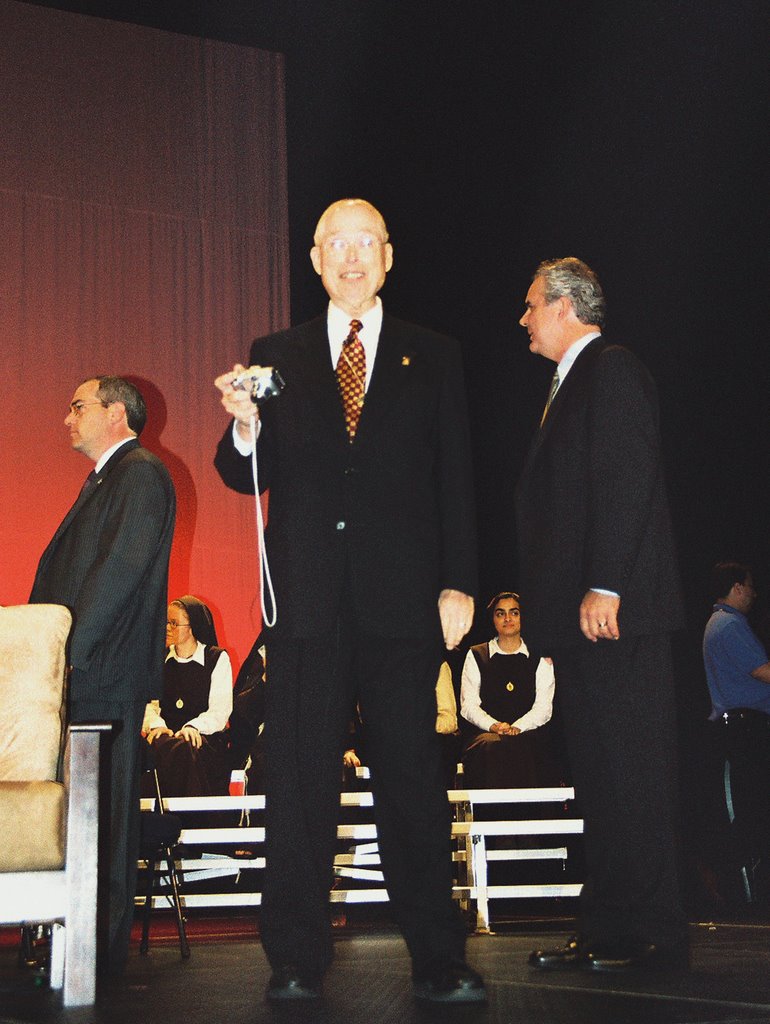
My latest adventure was actually a letter I got Saturday from Deacon Bill Steltemeier, Chairman of EWTN. When I was at the 25th anniversary celebration in Birmingham I took a photo of him on stage that is cute because he turned the whole fan thing around by taking photos of those of us who were taking photos of the people on the stage.


I met Deacon Bill the first time I went to the Shrine of the Blessed Sacrament back in June, and I told him that I was inspired by the fact that I had somehow gotten into Arroyo's World Over Live show as an audience of one the night before, and that I thought that the next thing would be that I would be able to meet Mother Angelica. Deacon Bill told me her health was so poor that she only got out of bed for a few minutes every day, so meeting her was out of the question. Can't trust all inspirations, I guess.

Anyway I sent a photo to Deacon Bill of him with his camera, along with a photo of Raymond Arroyo squeezing my hand and me beaming away, plus the Arroyo interview article I published in San Francisco Faith. I wrote Deacon Bill that I had started watching EWTN after my Israeli pilgrimage last November where I met Fr. Joseph Mary Wolfe. Because he was such a good pure priest, I started watching EWTN Masses to see if I could see more of Fr. Joseph.

Deacon Bill wrote me that when he repeated to Fr. Joseph what I had written about him being such a good pure priest, that Fr. Joseph blushed.

He also said there is only one Raymond Arroyo and that whereever he goes Raymond gets into things. He said that in the photo I sent him of the two of us, I made Raymond look good. Smile.

Here is a Catholic court jester link I found that shows celebrity look-alikes, and Raymond's celebrity look alike is Pee Wee Herman. www.splendoroftruth.com/curtjester/archives/004071.phpRegina Dittmann saw the resemblance before I ever chanced upon that website, but I didn't. In his defense, I have to add that Raymond is a much handsomer, vastly more intelligent, charming, and articulate not to mention hysterically funnier version of Pee Wee, always impeccably dressed in a very good suit. When I first met Arroyo after hearing him speak at the EWTN 25th anniversary in San Francisco, I said, "Did anyone ever tell you you're a riot?" He said, "Well, I"ve started a few."]

Deacon Bill also said that if I come back to Huntsville and get back to the shrine I should say hi to him. And he sent me two mini-books
written by Mother Angelica. One of them called The Healing Power of Suffering is grabbing my attention and working on my heart.

Deacon Bill said his wife and he both enjoyed the picture of him with the camera. He added, "Keep up the good work." And then he added to his official signature "Love, Bill" with a smiley face.

Ain't that cute?

Love, Roseanne :-)

PS. One tie-in with what St. Ann choir is trying to do is that at EWTN, the ordinary (repeated) parts of the Mass are sung in Latin chant [except of course the Kyrie Eleison (Lord Have Mercy)--which is in Greek]. You may be interested in the following, which describes some misunderstandings about the actual intention of the Second Vatican Council as regards the Latin Mass, the use of chant, and which direction the priest is supposed to face, which were illustrated by Mother Angelica's struggles with the National Council of Catholic Bishops (NCCB), as detailed in Raymond Arroyo's NY TImes bestselling bio of Mother Angelica.

At EWTN's chapel they sing the Gloria (Glory to God), the Sanctus (Holy, Holy, Holy), Agnus Dei (Lamb of God), Pater Noster (Our Father) in Latin. According to Arroyo's book, Mother Angelica turned to Latin because she was distressed at the changes in the English translations that the American bishops were promoting in the early 90s. FIrst she set some of her nuns to reviewing the documents of Vatican II. "The nuns discovered that the Second Vatican Council had never intended a wholesale abandonment of Latin in the new Mass. Quite the contrary, the official council and papal documents encouraged the retention of Latin and use of Gregorian chant in the renewed Liturgy. . . .

"Though the Monastery [while it was still located in Birmingham before it moved to Hanceville] celebrated the new Mass of Vatican II, the priest with his back to the people, the sounds of the service, and the old devotions were often mistaken as a throwback to a bygone era. In point of fact, it was much closer to the renewal foreseen by the Second Vatican Council--and it was beaming into nearly every diocese in America."

On the topic of the priest facing away from the people (ad orientem) the book details a momentous struggle between Mother Angelica and Bishop Foley of Birmingham in concert with the 'National Council of Catholic Bishops (NCCB). The NCCB was up in arms over Mother's choice to have the friars say the Mass facing away from the people. Bishop Foley issued a decree banning ad orientem Masses as "'an illicit innovation or sacrilege' of the priest turning his back to the people," but Mother Angelica eventually won her struggle because Cardinal Ratzinger was on the same side.

"Cardinal Ratzinger had long espoused the virtues of the ad orientem priestly posture, saluting its theological emphasis--principally the unified orientation of the priest and the people offering sacrifice to God rather than to one another." A fax came from the Vatican Congregation for Divine Worship and Discipline of the Sacraments ruling against Bishop Foley's decree of prohibition.

Bishop Foley and his cohorts lost that battle, but the bishop got in another lick. When Mother Angelica dedicated her new 55 million dollar Shrine of the Blessed Sacrament in Hanceville with its golden fixed altar, centrally located gold tabernacle, massive gold altarpiece (reredos), and eight foot monstrance of gold and precious stones, the bishop couldn't ban ad orientem Masses, but he could and did ban televising them. Mother Angelica dug in her heels, and no Masses have ever been broadcast from the new Shrine, because all Masses at the Shrine are always said by the priest in the ad orientem posture.

Meanwhile, EWTN beams Masses from the original much-humbler chapel in Birmingham adjacent to the TV station 75 miles away in Birmingham, and there the Mass is sung mostly in Latin chant with the exception of the homily, readings, and some prayers, but with the priest facing the people.

I think it's important to note that the Vatican sent Cardinal Alfonso Lopez Trujillo, President of the Pontifical Council for the Family, to preside at the Mass and join the final EWTN 25th anniversary celebration that was held in Birmingham. Bishop Foley came too. The Mass was said facing the congregation.

Pope St. Pius V's, G.K. Chesterton's and Benedict XVI's Lepanto, With a Little Serendipity Thrown In At the End

As I prepared to sing Latin chant and polyphony at the St. Ann Choir at Our Lady of Peace Church at 7:30 this evening on the Feast of Our Lady of the Rosary, I was drawn to do some googling to find out more about the Catholic victory at the Battle of Lepanto that is celebrated today.

As some of you know, the Feast of Our Lady of the Rosary was instituted by Pope St. Pius V after the victory of Catholic forces over the Turkish Muslims in the Gulf of Lepanto (Gulf of Corinth) Greece in 1571.

A National Catholic Register article on 9/26/2006 referred to the current disturbances with Muslims after the Pope's remarks in Bavaria as "Benedict's Lepanto." I don't know yet whether I agree about the parallels drawn in the article, but it's an interesting thesis. The writer said that the current Pope is using another type of weaponry in the current conflict, that of dialogue on faith and reason.

Quote: "For [Benedict], dialogue means telling the truth in love, no matter what the consequence – even when it infuriates." [http://www.catholic.org/views/views_news.php?id=21409]

Hmm ...

Back to October 7, 1571: It is said that the sainted Pope St. Pius V learned immediately about the Lepanto victory by supernatural means. A rousing account of the significance and history of the battle from http://www.stormfront.org/forum/showthread.php?p=3003310 includes this passage of what happened after the victory:

Quote: "Don Juan [of Austria, Philip II's illegitimate half brother] at once sent ten galleys to Spain to inform the King, and dispatched the Count of Priego to Rome. But Pius V had speedier means of communication than galleys. On the afternoon of Sunday, October seventh, he was walking in the Vatican with his treasurer, Donata Cesis. The evening before he had sent out orders to all convents in Rome and nearby to double their prayers for the Victory of the Christian fleet, but now he was listening to a recital of some of his financial difficulties. Suddenly he stepped aside, opened a
window, and stood watching the sky as if astonished. Then, turning with a radiant face to the treasurer, he said,
`Go with God. This is not the time for business, but to give thanks to Jesus Christ, for our fleet has conquered.'"

The Muslim Turks had been on a wave of conquest for centuries. The last holdout city on the island of Cypress had recently fallen. As G.K. Chesterton wrote in his poem about the battle, Venice was threatened. Some say the battle of Lepanto helped turn the tide of conquest and save the Christian world from total dominance by the Muslim Turks.

You can read the quite stirring Chesterton poem at: http://www.dur.ac.uk/martin.ward/gkc/books/lepanto.html.

We Catholics believe that Our Lady of the Rosary's powerful intercession helped save the day. Interesting enough, the general's ship had two banners one with Christ Crucified on it and other with the image of Our Lady of Guadalupe.

Miguel Cervantes author of Don Quixote fought in that battle and spent five years afterwards in a Barbary coast prison. How about the following for colorful language and gritty details?

Quote: "1571 Cervantes participates in the Spanish naval victory at Lepanto, against the Turks, under the command of don Juan of Austria. Cervantes loses the use of his left hand, for which he becomes known as "the Gimp of Lepanto." (This is politically incorrect language and you won't get such a candid translation of "El Manco de Lepanto" at Wikipedia. I think, however, that out of respect for Cervantes and naval warfare, my final translation would be, "The Lost Hand of Lepanto.")

"1575-1580 Cervantes is held prisoner in Algiers by Barbary pirates for five years. He tries to escape four times. Cervantes' ransom is super-steep because, upon capture, he carried letters of recommendation from don Juan of Austria. This led the presumptuous and greedy (and no-doubt smelly) pirates to believe that Cervantes was a man of high birth and, like John McCain when he was shot down over North Vietnam, a real "catch." http://www.stormfront.org/forum/showthread.php?p=3003310

----------
Totally by accident, as I was about to send the above in an email, I somehow double- clicked an old message from October 16, 2000! in my inbox that is about this very topic. This is too much serendipity for me to handle. Honest. Read it and see!

From: FrTSmith@aol.com
Subject: The Rosary: A Cherished Prayer
Date: October 16, 2000 7:28:19 AM PDT
To: StMaryNL@worldnet.att.net

The Rosary: A Cherished Prayer

By Father William Saunders

My Protestant friend was asking me about the Rosary — where it came from and what it means. Could you help me so I can tell her? — A reader in Haymarket

The Rosary is one of the most cherished prayers of our Catholic Church. Introduced by the Creed, the Our Father, three Hail Mary's and the Doxology ("Glory Be"), and concluded with the Salve Regina, the Rosary involves the recitation of five decades consisting of the Our Father, 10 Hail Mary's, and the Doxology. During this recitation, the individual meditates on the saving
mysteries of our Lord's life and the faithful witness of our Blessed Mother. Journeying through the Joyful, Sorrowful, and Glorious mysteries of the Rosary, the individual brings to mind our Lord's incarnation, His passion and death, and His resurrection from the dead. In so doing, the Rosary assists us in growing in a deeper appreciation of these mysteries, in uniting our life more closely to our Lord, and in imploring His graced assistance to live the faith. We also ask for the prayers of our Blessed Mother, the exemplar of faith, who leads all believers to her Son.

The origins of the Rosary are "sketchy" at best. The use of "prayer beads" and the repeated recitation of prayers to aid in meditation stem from the earliest days of the Church and has roots even in pre-Christian times. Evidence exists from the Middles Ages that strings of beads were used to help a person count the number of Our Fathers or Hail Marys recited. Actually, these strings of beads became known as "Paternosters," the Latin for "Our Father."

The structure of the Rosary gradually evolved between the 12th and 15thcenturies. Eventually 50 Hail Marys were recited and were linked with verses of psalms or other phrases evoking the lives of Jesus and Mary. During this time, this prayer form became known as the rosarium ("rose garden"), actually a common term used to designate a collection of similar material, such as an anthology of stories on the same subject or theme. Finally, during the 16th century, the structure of the five decade Rosary based on the three sets of mysteries prevailed.

Tradition does hold that St. Dominic (d. 1221) devised the Rosary as we know it. Moved by a vision of our Blessed Mother, he preached the use of the Rosary in his missionary work among the Albigensians, who had denied the mystery of Christ. Some scholars take exception to St. Dominic's actual role in forming the Rosary since the earliest accounts of his life do not mention it, the Dominican constitutions do not link him with it, and contemporaneous paintings of St. Dominic do not include it as a symbol to identify the saint.

In 1922, Dom Louis Gougaud stated, "The various elements which enter into the composition of that Catholic devotion commonly called the Rosary are the product of a long and gradual development which began before St. Dominic's time, which continued without his having any share in it, and which only mattained its final shape several centuries after his death." However, other scholars would rebut that St. Dominic not so much "invented" the Rosary as he preached its use to convert sinners and those who had strayed from the faith. Moreover, at least a dozen popes have mentioned St. Dominic's connection with the Rosary in various papal pronouncements, sanctioning his role as at least a "pious belief."

The Rosary gained greater popularity in the 1500s. At this time, the Moslem Turks were ravaging eastern Europe. Recall that in 1453, Constantinople had fallen to the Moslems, leaving the Balkans and Hungary open to conquest. With Moslems raiding even the coast of Italy, the control of the Mediterranean was now at stake. In 1571, Pope Pius V organized a fleet under the command of Don Juan of Austria, the half-brother of King Philip II of Spain. While preparations were underway, the Holy Father asked all of the faithful to say the Rosary and implore our blessed Mother's prayers, under the title Our Lady of Victory, that our Lord would grant victory to the Christians. Although the Moslem fleet outnumbered that of the Christians in both vessels and sailors, the forces were ready to meet in battle. The Christian flagship flew a blue banner depicting Christ crucified. On October 7, 1571, the Moslems were defeated at the Battle of Lepanto. The following year, Pope St. Pius V in thanksgiving established the Feast of the Holy Rosary on October 7 where the faithful would not only remember this victory, but also continue give thanks to the Lord for all of His benefits and remember the powerful intercession of our Blessed Mother.

Mindful of the action of Pope Pius V, our Holy Father, Pope John Paul II, in an Angelus address given in October, 1983, stated, "The Rosary also takes on fresh perspectives and is charged with stronger and vaster intentions than in the past. It is not a question now of asking for great victories, as at Lepanto and Vienna, rather it is a question of asking Mary to provide us with valorous fighters against the spirit of error and evil, with the arms of the Gospel, that is, the Cross and God's Word. The Rosary prayer is man's prayer for man. It is the prayer of human solidarity, the collegial prayer of the redeemed, reflecting the spirit and intent of the first of the redeemed, Mary, Mother and Image of the Church. It is a prayer for all the people of the world and of history, living and dead, called to be the Body of Christ with us and to become heirs together with Him of the glory of the Father."

The fact that our Church continues to include the Feast of the Holy Rosary on the liturgical calendar testifies to the importance and goodness of this form of prayer. Archbishop Fulton Sheen said, "The Rosary is the book of the
blind, where souls see and there enact the greatest drama of love the world has ever known; it is the book of the simple, which initiates them into mysteries and knowledge more satisfying than the education of other men; it is the book of the aged, whose eyes close upon the shadow of this world, and open on the substance of the next. The power of the Rosary is beyond description."

- Fr. Saunders is dean of the Notre Dame Graduate School of Christendom College in Alexandria and pastor of Our Lady of Hope Parish in Potomac Falls.